Road to COP31 in Antalya 2026
Road to COP31 in Antalya: The Climate Summit That Could Determine Our Future
Every year, the climate calendar builds toward one defining moment. For 2026, that moment arrives on the sun-drenched shores of the Mediterranean, in the Turkish city of Antalya — a place known for turquoise waters, ancient ruins, and now, quite unexpectedly, one of the most consequential diplomatic gatherings on the planet.
The 31st Conference of the Parties to the UNFCCC — COP31 — will convene at the Antalya Expo Center from November 9 to 20, 2026. And it arrives at a moment when the language of climate diplomacy is shifting decisively from promise to proof.
After years of landmark agreements and hard-won commitments, the world is running out of runway. The Paris Agreement’s 2030 milestones are no longer abstract targets on a distant horizon — they are deadlines that are nearly upon us. COP31 in Antalya is the summit where negotiators, heads of state, scientists, civil society leaders, and millions of ordinary citizens will discover whether the promises made in Paris, Glasgow, Dubai, and Belém are being kept.
This is not just another climate conference. It is, in many ways, the implementation summit — and the road to Antalya is already revealing just how much work remains to be done.
Road to COP31 in Antalya, Türkiye
For the fifth consecutive year, The British University in Egypt and UNDP Egypt are proud to organise the COP Simulation Programme, an annual international initiative that brings together students from around the world to simulate the Conference of the Parties (COP).
The Programme is designed to develop students’ skills in climate literacy, diplomacy, negotiation, and policy advocacy, while also enhancing youth capacities in research, evidence-based policy development, leadership, teamwork, and innovation.
It provides hands-on experience in climate action and policymaking, offers exposure to soft diplomacy and engagement on international climate platforms, promotes cross-cultural collaboration among participants from diverse backgrounds, and contributes to shaping them as active climate agents and advocates.
Over the past four years, approximately 160 youth participants have joined the Programme annually, representing diverse backgrounds, nationalities, and universities worldwide.
Due to its significant impact, the COP Simulation Programme is held under the auspices of the Ministry of Foreign Affairs, International Cooperation and Egyptian Expatriates Affairs, the Ministry of Higher Education and Scientific Research, and the Ministry of Youth and Sports, in collaboration with the British Embassy in Cairo, and is supported by a wide range of national and international institutions.
Each year, the COP Simulation is organised in partnership with a leading academic institution from the country holding the COP Presidency. COP28 Simulation was held in partnership with Zayed University in UAE, COP29 Simulation with ADA University in Azerbaijan, and COP30 Simulation with both Federal University of Pará and Federal University of Rio de Janeiro in Brazil.
The COP30 Simulation Programme, which continues to grow each year, introduced two innovative research labs: the Debt Alliance and Climate Finance Lab, and the Just Transition Lab. These initiatives produced two final communiqués that were presented at COP30 in Belém.
Participants who will successfully complete the Programme will receive official certificates recognising their excellence in:
- Climate diplomacy and advocacy
- International negotiation skills
- Climate policy research
We are excited to announce that we are now on the road to COP31 in Antalya, and preparations are underway for the COP31 Simulation Programme. Applications are now open!
Why Antalya? Understanding the Host City and Its Climate Context
The choice of Antalya as the venue for COP31 carries more symbolic weight than it might initially appear. Turkey — or Türkiye, as the country formally rebranded — is a nation straddling two continents, bridging the Global North and the Global South, and facing firsthand the consequences of a warming Mediterranean.
Antalya sits on the front line of the climate crisis in ways that are both measurable and viscerally felt. The city experiences record-breaking summer temperatures, shifting rainfall patterns that threaten its agricultural hinterland, and sea-level pressures on its coastline. Hosting COP31 here is, in a sense, a statement: this is not an abstract problem debated in distant conference halls. It is happening here, now, to real communities.
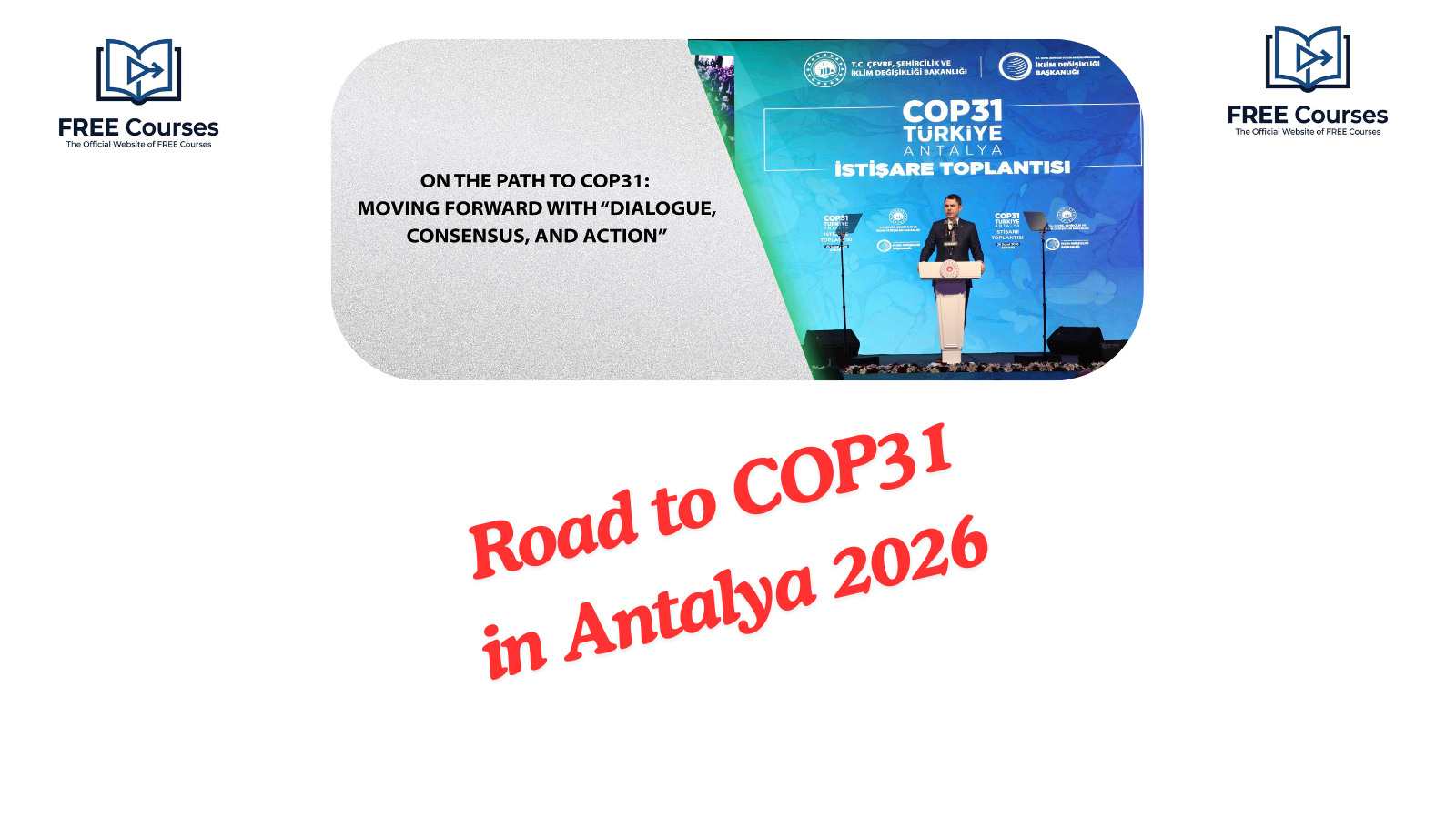
The road to hosting COP31 was itself an exercise in geopolitical complexity. Both Türkiye and Australia submitted bids to host the conference. Rather than force a divisive vote, the two nations negotiated an unprecedented co-leadership arrangement: Türkiye would serve as the formal host and provide the COP Presidency, while Australia would take on the lead negotiation role. Murat Kurum, Turkey’s Minister of Environment, Urbanization and Climate Change, serves as COP President-Designate.
This dual-presidency model is genuinely new in the history of UNFCCC conferences — and it adds a layer of diplomatic complexity that will shape every aspect of how the Antalya summit unfolds.
From Belém to Antalya: What COP30 Left on the Table
To understand what is at stake on the road to COP31, you need to understand where COP30 left off. The Belém climate conference in November 2025 delivered a mixed inheritance.
On the positive side, nations agreed to mobilize $1.3 trillion annually by 2035 for climate action — a historic finance commitment that dwarfs previous targets. Countries pledged to triple adaptation finance to approximately $120 billion per year, acknowledging for the first time that the world must invest as aggressively in coping with climate change as it does in preventing it. The Belém Mission to 1.5°C was launched, and the Global Implementation Accelerator was established to help countries translate commitments into action.
But the conference also stumbled in critical areas. Perhaps most conspicuously, negotiators failed to agree on a concrete roadmap for phasing out fossil fuels — despite the backing of more than 80 countries. The language around coal, oil, and gas remained carefully hedged, frustrating climate advocates who had hoped for something more definitive after the COP28 “transition away from fossil fuels” pledge.
COP31 in Antalya now inherits this incomplete agenda. And while the official mandate is framed around “implementation,” the deeper question is whether the political will exists to close the gaps that Belém could not.
The Core Priorities on the Road to COP31
1. NDCs 3.0 — The Third Generation of National Climate Plans
At the heart of the COP31 agenda is the review of the third generation of Nationally Determined Contributions, or NDCs 3.0. These are the national climate plans that each country submits to the UNFCCC, outlining their emissions reduction targets and adaptation strategies for the period up to 2035.
The NDC cycle is the engine of the Paris Agreement — the mechanism by which global ambition is supposed to ratchet upward over time. The question in Antalya will be whether the new NDCs submitted in 2025 are genuinely stronger than their predecessors, or whether they represent the same pledges repackaged with updated dates.
Early analysis from climate science institutions suggests that even the most ambitious NDCs on the table fall significantly short of what is needed to stay within 1.5°C of warming. The emissions gap — the difference between where we are headed and where we need to be — remains stubbornly wide. Closing it is perhaps the most urgent item on the Antalya agenda.
2. The $1.3 Trillion Finance Question
Climate finance is the lubricant of international climate diplomacy, and the road to COP31 is dominated by one number: $1.3 trillion. That is the annual climate finance commitment agreed at COP30 — money that developed nations and multilateral institutions have pledged to mobilize for developing countries by 2035.
But mobilizing and delivering are very different things. The New Collective Quantified Goal (NCQG) established in Baku at COP29 provided the framework; COP31 must provide the accountability. Developing nations, particularly those in Africa, South Asia, and the Pacific, are watching closely to see whether the pledges made in Belém translate into real capital flows — or whether they join the long list of climate finance commitments that sounded better in a press release than they looked in practice.
3. Loss and Damage — From Fund to Function
The establishment of a Loss and Damage fund was celebrated as a breakthrough at COP27 in Sharm el-Sheikh. Since then, the fund has been operationalized — but questions about its scale, governance, and accessibility persist. COP31 is expected to grapple with whether the fund is actually reaching the communities most vulnerable to irreversible climate impacts: the farmers watching their soil erode, the coastal communities watching their shores disappear, the cities managing floods they never planned for.
4. Adaptation — Turning Rhetoric into Reality
Adaptation has long been the underfunded stepsister of mitigation in climate finance. The pledge to triple adaptation finance at COP30 was a significant signal, but the Global Goal on Adaptation — agreed at COP28 — now enters a critical phase. In Antalya, it will no longer be sufficient to say adaptation is a priority. Countries will face pressure to demonstrate measurable progress: early warning systems deployed, climate-resilient infrastructure built, agricultural adaptation strategies implemented.
5. The Fossil Fuel Question That Wouldn’t Go Away
The road to Antalya runs directly through the unresolved question of fossil fuel phase-out. With the Trump administration in the United States having formally withdrawn from the Paris Agreement once again, and with geopolitical tensions complicating coordinated action, the prospects for a clear fossil fuel commitment at COP31 are uncertain. Yet the scientific case for accelerating the energy transition has never been stronger, and the economic case — driven by rapidly falling renewable costs — is increasingly compelling even without policy mandates.
The Geopolitical Landscape Shaping COP31
It would be naive to analyze the road to COP31 without acknowledging the geopolitical turbulence surrounding it. Climate conferences do not happen in a vacuum — they happen in a world of competing national interests, shifting alliances, and deepening great-power rivalry.
The United States’ re-withdrawal from the Paris Agreement under the current administration has created a significant vacuum in global climate leadership. While individual US states, cities, and corporations continue to pursue ambitious climate goals, the absence of federal engagement removes a critical political and financial anchor from the negotiations.
Meanwhile, China and the European Union have emerged as the de facto co-anchors of the multilateral climate process. China’s progress on renewable energy deployment — it now leads the world in solar and wind installation capacity — provides a counternarrative to the pessimism generated by US withdrawal. The EU’s Green Deal, despite facing political headwinds domestically, remains the most comprehensive regulatory framework for emissions reduction in the world.
For Türkiye, hosting COP31 represents an opportunity to reposition itself on the international stage. Turkey ratified the Paris Agreement only in 2021, relatively late compared to most nations. COP31 is a chance to demonstrate genuine climate leadership — not just as a conference host, but as a country willing to embrace the energy transition that its geography (exceptional solar and wind resources) makes particularly promising.
The Voice of the Vulnerable: Pacific Nations and Climate Justice
One of the most distinctive features of the COP31 arrangement is the prominent role given to Pacific Island nations. In the weeks before the main conference, a pre-COP gathering is planned in Fiji, with a leaders’ event in Tuvalu — a country that faces genuine existential threat from sea-level rise.
This is not merely symbolic. The Pacific nations have long been among the most eloquent and urgent voices in the climate debate, precisely because they are among the first to face the consequences of global inaction. Their inclusion in the COP31 leadership structure — through Australia’s negotiating role and the Pacific pre-COP events — is intended to ensure that the voices of the most vulnerable are not marginalized by the realpolitik of major emitters.
For many in the Pacific, the road to Antalya is a road to survival. Tuvalu’s elevation above sea level measures in centimeters. The Marshall Islands face regular flooding of its capital. Kiribati has already begun purchasing land in Fiji as contingency planning for potential relocation. These are not hypothetical futures — they are present-day realities that COP31 must confront honestly.
The COP31 Action Agenda: Ten Priority Areas
The Turkish COP31 Presidency has outlined a framework of ten priority areas that will shape the conference’s Action Agenda. The approach rests on three core principles: complementarity (building on existing initiatives rather than duplicating them), addressing implementation gaps (focusing where policy ambition has not yet translated into action), and inclusive ownership (ensuring that countries at all levels of development have a voice in the process).
Finance, technology transfer, and capacity building are designated as “horizontal enablers” — cross-cutting themes that run through every priority area. This framing reflects a mature understanding of why previous COP commitments have fallen short: it is not always a lack of ambition, but a lack of the tools needed to act on that ambition.
COP31 seeks to provide an implementation-focused, inclusive and practical framework that can connect climate priorities with concrete action. — Official COP31 Türkiye Presidency Statement
The Action Agenda is being shaped through a broad consultative process running up to its formal announcement at the Bonn SB64 session in June 2026 — a process that includes NGO consultation, business engagement, and scientific input in ways that signal genuine attempts at inclusive governance.
Who Needs to Show Up — and How
Governments: Delivering on the Implementation Mandate
For national governments, the road to COP31 is measured in NDC submissions, climate budget commitments, and policy legislation. The most credible climate commitments at COP are those backed by domestic law. Countries heading to Antalya with enacted climate legislation — carbon pricing, renewable energy mandates, building codes, transport electrification roadmaps — carry far more diplomatic weight than those arriving with pledges unsupported by policy reality.